

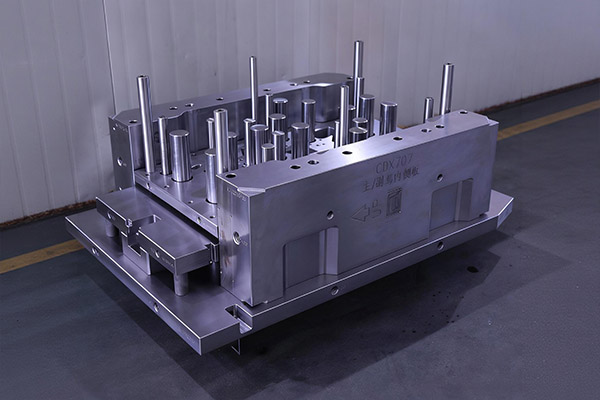
As the mold manufacturing industry evolves towards larger, more precise, and more complex products, the mold base, serving as the "skeleton" of the mold, is experiencing significant shifts in its market landscape. In recent years, the market share of non-standard mold bases has continued to expand. According to industry data, their share has now reached 60-70% of total mold base sales. This trend fundamentally reflects the differentiated performance requirements for molds from downstream industries.
For mold purchasers, understanding the essential differences between standard and non-standard mold bases and making accurate selections in practical applications is key to controlling costs and improving production efficiency. This article will delve into the differences between the two from three dimensions: structural characteristics, cost composition, and application scenarios, and clarify when non-standard mold bases should be the primary consideration.
Defining the Difference: Mass Production vs. Deep Customization
To understand their differences, it's crucial first to recognize their distinct roles in the industrial chain.
Standard Mold Bases refer to products assembled by manufacturers using mass-produced, standardized components based on common industry standards (such as LKM, FUTABA, etc.). They are like "ready-to-wear clothing" in the apparel market, with fixed sizes and styles. Purchasers can "buy and use" them immediately or put them into production after minimal processing.
Non-standard Mold Bases, on the other hand, are customized products that involve deep processing, precision machining, or structural modification based on standard mold bases—or even completely deviating from standard frameworks—to meet specific customer product requirements. They are more akin to "bespoke tailoring," requiring dedicated design and manufacturing according to the usage scenario. This includes features like pre-machined insert pockets, slider mechanisms, or non-standard runner systems on the mold base itself, allowing the customer to install the mold core and proceed directly to trial production.
Core Differences: A Three-Dimensional Comparison of Structure, Cost, and Application
1. Structural Characteristics: Versatility vs. Adaptability
Standard mold bases feature highly uniform structures, primarily composed of components like the top clamp plate, cavity plate (A plate), core plate (B plate), support blocks (C plate), bottom clamp plate, ejector plate, ejector retainer plate, along with standard guide pins, return pins, etc. Their dimensions follow fixed series, with common width × length specifications ranging from 1515 to 5070 (typically in centimeters) and fixed increments for thickness. They typically do not involve complex machining like cutting pockets for mold inserts.
Non-standard mold bases exhibit significant flexibility and adaptability.
-
Dimensional Adjustment: When the maximum size of a standard mold base is insufficient for very large molds, or the minimum standard size still exceeds the space available for a small mold, non-standard bases can be tailor-made. For example, if the mold height capacity of an injection molding machine is limited, designers can modify a standard base into a non-standard structure without an ejection system to reduce the overall mold height.
-
Functional Integration: Non-standard bases often need to incorporate special mechanisms. For instance, a non-standard mold base designed for an electric vehicle measuring cup must facilitate "step-by-step sequential demolding" for thin-walled, deep-cavity plastic parts. Patent literature also describes "assembled non-standard mold bases" that use tongue-and-groove connections to stamp different part shapes.
-
Higher Precision Requirements: Fully machined non-standard plastic mold bases utilize precisely designed guide pin layouts, return springs, and threaded rods to ensure more accurate positioning and tighter integration during the stamping process.
2. Cost Composition: Apparent Unit Price vs. Total Implied Cost
The core advantage of standard mold bases lies in cost-effectiveness and speed.
-
Lower Cost: Mass production and standardized components significantly reduce material and processing costs.
-
Shorter Lead Time: As mature standard parts, they are often kept in stock, enabling quick delivery—sometimes even "buy and use"—which drastically shortens the overall mold manufacturing cycle.
The cost structure for non-standard mold bases is more complex, with a higher apparent unit price that may, however, offset the total mold cost.
-
Increased Design Costs: Non-standard bases require additional engineering design, including 3D mold drawings, 2D shop drawings, and even mold flow analysis reports. These costs are factored into the final price.
-
Material and Machining Premium: They may involve special steels (such as S136, NAK80, etc.) and require more extensive CNC machining, EDM, deep hole drilling, and other processes, leading to significantly higher processing fees.
-
Potential Implicit Savings: Although the purchase price of a non-standard mold base is higher than a standard one, it reduces the subsequent modification and fitting work required by the mold maker for complex products. By offloading precision machining tasks upstream to the mold base supplier, this approach actually optimizes industrial division of labor and can potentially lower the overall development cost of the mold.
3. Usage Scenarios: Universal Platform vs. Dedicated Platform
Standard mold bases are suitable for conventional products and general-purpose molds. When a product has a simple structure, requires medium production volumes, and has no special requirements for mold functions (like specific ejection or cooling methods), the standard mold base is the most economical and efficient choice.
Non-standard mold bases are primarily applied in the following three scenarios:
-
Scenario 1: When Physical Size Exceeds Standard Series Capabilities
When a product is either very large (e.g., automotive body panels, large home appliance casings) or involves micro-precision components, causing the maximum/minimum specifications of standard mold bases to be incompatible with the injection molding or stamping machine's platen size and clamping capacity, a non-standard base is mandatory. For example, the exceptionally large moving molds used in bridge construction for variable-width curved bridges are typical non-standard equipment. -
Scenario 2: When Product Structure Requires Special Mold Actions
If a plastic or stamped part has a complex internal geometry requiring the mold to perform special actions like sliders, lifters, sequential demolding, or rotating cores, the space预留 in standard mold bases is often insufficient or non-existent. In such cases, a non-standard mold base is needed to accommodate these complex mechanisms and provide precise guidance and support. The "three-step sequential demolding" for the electric vehicle measuring cup mentioned earlier is only possible with a specially designed non-standard base. -
Scenario 3: When Pursuing Ultimate Efficiency and Special Processes
For systems like hot runners, demanding temperature control (cooling circuit layout), or specialized ejection systems (e.g., ejector sleeves, stripper plates), non-standard mold bases allow for the pre-machining of related holes and mounting positions accurately. This not only ensures process precision but also avoids the efficiency loss and potential accuracy degradation associated with the mold shop performing these machining steps later.
Trend Outlook: The Standardization of Non-Standards
An interesting trend in the mold base industry is the movement towards the "standardization of non-standard products." As demand surges in specific application areas (such as automotive lightweighting components, medical disposables), mold base manufacturers are beginning to summarize new "standard solutions" tailored to these niches. This approach—customized mass production within a defined scope—retains adaptability to product characteristics while, to some extent, shortening delivery times and controlling costs.
In conclusion, choosing between a standard and a non-standard mold base essentially involves weighing efficiency, cost, and adaptability. For mold purchasers, clearly defining the product's functional requirements, budget constraints, and precision levels is a prerequisite for effective communication with suppliers and achieving an optimal return on investment.